Your Room Is the Problem: The Acoustic Truth Bedroom Producers Keep Ignoring
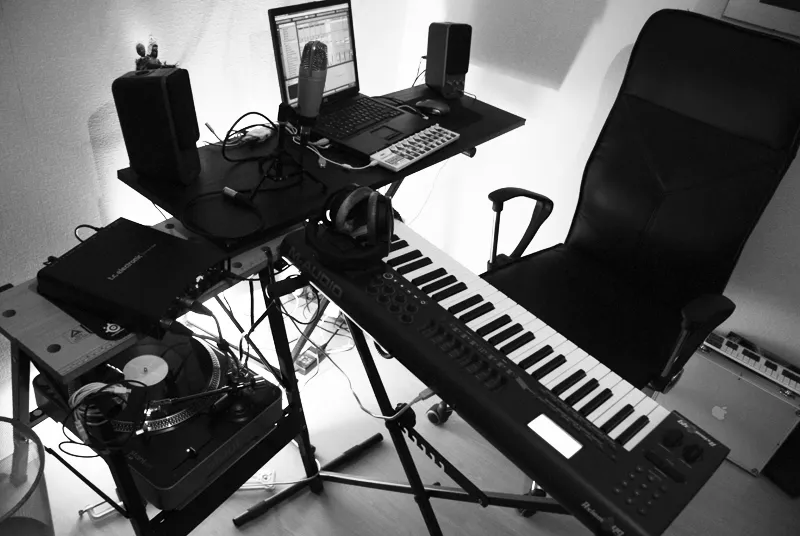
Photo: LiquidMolly, CC BY-SA 2.0, via Wikimedia Commons
Here's a scenario that plays out in home studios across the country about ten thousand times a week. A producer finishes a track, bounces it down, throws it on in the car, and immediately wants to set their laptop on fire. The low end is a disaster. The mids are honky and weird. The stereo image that sounded so wide on the monitors sounds like it's coming out of a tin can.
So what do they do? They go online. They read forum posts. They watch YouTube videos from guys with spotless studios and suspiciously symmetrical acoustic panels. And eventually, they convince themselves the problem is their monitors. Or their audio interface. Or maybe they need better reference tracks. Or a different DAW.
What almost nobody does is walk to the corner of their room and clap their hands.
That sharp, reverberant slap you hear? That's the sound of your actual problem.
The Gear Blame Spiral Is Real — and Expensive
There's a well-documented psychological tendency among producers, especially those working in isolation, to externalize the source of mix problems. When something sounds off, the instinct is to look outward — at the tools — rather than inward at the environment. It's the same logic that leads a golfer to buy new clubs instead of taking lessons.
The acoustic treatment industry, to put it bluntly, has also done a pretty good job of making the solution feel more complicated and expensive than it actually is. Walk into any big-box music retailer or scroll through any gear site and you'll find wall-to-wall foam panels, bass traps, diffusers, and cloud baffles that together could run you upward of $1,500 before you've treated a single corner properly.
The cruel irony is that most of those foam panels — the thin, wedge-cut stuff you see stapled to walls in dorm-room studios — do almost nothing useful. They absorb high-frequency air movement just fine, which actually makes the room sound worse in some cases by creating an environment that's deadened on top but still completely untreated in the low end.
You've essentially built a room that lies to you in a new and more expensive way.
What's Actually Happening in Your Untreated Room
Sound bounces. That's the whole problem, summarized. When a woofer pushes air, that air hits walls, floors, and ceilings and comes back at your ears milliseconds after the direct signal does. Those reflections combine with the original sound and either reinforce certain frequencies or cancel them out, depending on timing and distance.
The result is what acousticians call a "room mode" — a standing wave that builds up energy at specific frequencies based on your room's dimensions. In a typical American bedroom, which might measure something like 10 x 12 feet with 8-foot ceilings, you're going to have serious energy buildup somewhere in the 40–100 Hz range. That's exactly where kick drums, bass lines, and sub-bass elements live.
When you're making mix decisions in that environment, you're essentially working blind in the most important part of the frequency spectrum. You might cut bass because it sounds boomy on your monitors, only to have the track sound thin everywhere else. Or you pile on sub because it seems weak, and then wonder why the track sounds like a foghorn on anything with real speakers.
This isn't a gear problem. It's a physics problem.
The Free Diagnostic That Most People Skip
Before spending a dollar on treatment, do this: download a free room analysis app — Room EQ Wizard is the gold standard and it costs nothing — and run a sweep tone through your monitors while measuring from your mix position with a USB microphone or even a decent phone mic. What you'll see is a frequency response curve that shows you exactly where your room is boosting or cutting frequencies.
Most producers, when they do this for the first time, experience something between shock and relief. Shock because the curve looks like a mountain range. Relief because they now know what they're actually dealing with.
That measurement will tell you more about your monitoring environment than any forum post or gear review ever will. And it gives you a roadmap for treatment that's actually targeted rather than decorative.
What Real Treatment Looks Like on a Real Budget
Here's the honest hierarchy of acoustic treatment, ranked by impact per dollar:
1. Bass traps in corners. Floor-to-ceiling corner treatment with thick, dense material — we're talking 4-inch rockwool or rigid fiberglass, not 2-inch foam — does more for mix translation than anything else you can do. Corners are where bass energy accumulates most intensely. Two floor-to-ceiling corner traps can cost under $150 in materials if you build them yourself, and the difference is not subtle.
2. First reflection points. The spots on your side walls, ceiling, and rear wall where sound bounces directly off toward your ears before the room can diffuse it. Treating these with panels of moderate thickness (2–4 inches) reduces the comb filtering that smears your stereo image and makes mids sound weird.
3. Monitor placement. This costs nothing. Pull your monitors away from the wall behind them. Aim them at your ears, not at your chest. Make sure they're equidistant from side walls. An hour of repositioning can produce results that would cost hundreds in panels to replicate.
4. A subwoofer correction plugin. If you've done the Room EQ Wizard measurement and you know your room has a 9 dB peak at 63 Hz, a correction EQ applied to your monitoring chain (not your mix bus) can compensate for some of what the room is doing. This doesn't fix the acoustic problem, but it gives you more accurate information while you work on the real solution.
The Placebo Upgrade Problem
One more thing worth naming: there's a thriving market for acoustic "treatments" that function primarily as visual signals that someone takes their studio seriously. Colorful foam tiles in herringbone patterns. Decorative diffuser panels that aren't deep enough to actually diffuse anything meaningful. Branded bass traps that are more marketing than material science.
None of this is inherently bad. If having a good-looking studio makes you want to spend more time in it, that's a legitimate quality-of-life purchase. But it should be understood for what it is — aesthetics — and not confused with actual acoustic engineering.
The real upgrade is the boring one. Dense material in the corners. Measurement before money. A willingness to accept that your room is the variable, not your gear.
The Bottom Line
Bedroom producers are some of the most resourceful people in music right now. They're making records that compete with major-label releases using setups that would have seemed absurd twenty years ago. But that resourcefulness hits a wall when the room itself becomes the enemy.
You don't need a professional acoustic engineer. You don't need a renovation budget. You need a measurement, a corner, and some dense material. The frequencies are all there in your music — your room is just deciding which ones you actually get to hear.