More Isn't More: The Sample Rate Myth Costing You CPU and Credibility
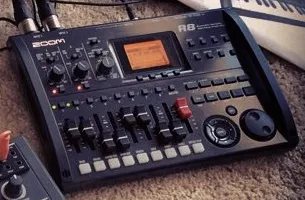
Photo: Arturia MicroBrute & ZOOM R8.jpg: Attila Malarik from Dubai, UAE derivative work: Clusternote (talk), CC BY-SA 3.0, via Wikimedia Commons
There's a particular kind of producer flex that's been circulating in online forums and gear threads for years now. It goes something like this: I only record at 192kHz. Anything less is basically MP3-tier garbage. It gets typed with total confidence, usually right before someone recommends a $3,000 audio interface to a bedroom producer who can barely afford rent.
Here's the thing, though. That flex? It's mostly vibes. And the science has been quietly disagreeing with it for a long time.
What Sample Rate Actually Means
Let's back up for a second. Sample rate is the number of times per second your audio interface captures a snapshot of an analog audio signal and converts it to digital data. The higher the number, the more snapshots per second. At 44.1kHz — the standard for CDs since the early 1980s — your interface is grabbing 44,100 of those snapshots every single second.
Now here's where Harry Nyquist enters the chat. The Nyquist-Shannon sampling theorem, which has been foundational to digital audio theory since the mid-20th century, states that you need a sample rate at least twice as high as the highest frequency you want to capture. Human hearing tops out somewhere around 20kHz for most adults — and realistically closer to 15–17kHz once you're past your early twenties and have been to a few too many warehouse parties.
Do the math: 44.1kHz captures everything up to roughly 22kHz, which already blows past the ceiling of what human ears can perceive. So what exactly is 192kHz capturing? Frequencies that dogs might theoretically appreciate, and ultrasonic content that your speakers can't reproduce and your listeners can't hear.
The Arms Race Nobody Asked For
So how did we get here? A few forces converged to make high sample rates feel like a necessity rather than a marketing angle.
Audio interface manufacturers needed new specs to sell new hardware. DAW developers followed suit, adding 192kHz support to their feature lists. Studio professionals, always sensitive to appearing behind the curve, started speccing sessions at higher rates to signal seriousness. And the internet did what the internet does — amplified the loudest voices until "192kHz or bust" became received wisdom in a lot of communities.
None of that is inherently malicious. But it created a situation where a lot of producers — especially newer ones — are running sessions at sample rates that their computers hate, their plugins weren't fully optimized for, and that deliver zero perceptible benefit to the end listener.
The computational cost is real. Running a session at 192kHz versus 44.1kHz doesn't just double your CPU load — it can increase it by a factor of four or more, depending on how your plugins handle the extra data. That means more latency, more dropouts, shorter plugin chains before your machine starts choking. You're literally trading performance for nothing your audience can hear.
What the Producers Who've Moved On Are Saying
Talk to working electronic producers who've been doing this long enough to have experimented with the full range of settings, and a pretty consistent picture emerges. The ones still running 192kHz sessions tend to be either working in post-production for film (where specific technical deliverables sometimes apply) or still chasing a placebo they bought into years ago.
The ones who've dropped back down to 44.1kHz or 48kHz — the latter being standard for video and broadcast work — describe it less as a sacrifice and more as a relief. Sessions run cleaner. Plugin counts go up. Workflow gets faster. And when they A/B their final mixes against 192kHz projects, the difference is, at best, imperceptible and more often completely nonexistent.
Some producers working in experimental and ambient spaces do make a case for 88.2kHz as a middle-ground option — particularly when doing heavy pitch manipulation or time-stretching, where having extra data to work with during processing can reduce artifacts before you downsample for the final render. That's a legitimate technical argument. But it's a far cry from the blanket claim that higher is always better.
The Downsampling Argument, Examined
One of the more persistent justifications for high sample rates goes like this: even if humans can't hear above 20kHz, recording at a higher rate gives you more headroom during processing, and when you downsample to 44.1kHz for the final master, the result is cleaner than if you'd worked at 44.1kHz the whole time.
This idea has some basis in reality, particularly in analog-to-digital conversion hardware from earlier eras where anti-aliasing filters introduced phase distortion near the Nyquist frequency. Recording at a higher rate pushed those filter artifacts further up the spectrum, away from the audible range, and the resulting downsample was cleaner.
Modern converters, though, have largely solved that problem. The anti-aliasing filters in contemporary interfaces are dramatically better than what existed even a decade ago. The argument that you need 192kHz to compensate for converter limitations is increasingly a solution to a problem that high-quality modern hardware doesn't really have anymore.
So What Should You Actually Use?
For most electronic music production — and honestly, for most music production period — 44.1kHz at 24-bit depth is the sweet spot. You get dynamic range that exceeds what any playback system or listener can distinguish, full coverage of the entire audible frequency spectrum, and sessions that your computer can actually run without sounding like a jet engine.
If you're producing music specifically for video, sync, or broadcast, 48kHz is the industry standard and worth matching from the start to avoid resampling later. If you're doing extreme pitch manipulation or heavy granular processing and you have a machine that can handle it without breaking a sweat, 88.2kHz is a defensible choice for the session — just render your final master at 44.1kHz.
And 192kHz? Save it for the spec sheet flexing. Your CPU will thank you. Your listeners won't know the difference, because there isn't one.
The Real Upgrade Nobody's Talking About
Here's the uncomfortable truth buried under all the sample rate discourse: the variables that actually determine whether your music sounds good have almost nothing to do with how many kHz you're running. Room acoustics, monitor placement, gain staging, the quality of your source sounds, the decisions you make during arrangement and mixing — these are the levers that move the needle.
Chasing 192kHz as a path to better-sounding music is the audio equivalent of buying faster running shoes when what you actually need is to train differently. The gear can only take you so far, and in this case, it's taking you somewhere you didn't need to go in the first place.
Ultrasonic Records has always been about pushing into the frequencies that matter — the ones you can feel, the ones that move people, the ones that define a sound. None of those live above 20kHz. They never did.